

How to Write High-Converting Cold Emails With ChatGPT
A comprehensive, step-by-step framework showing founders how to combine ChatGPT with strategic research to write personalized cold emails that generate 30%+ reply rates and book qualified meetings consistently.

Dudu
Feb 5, 2026
Last Updated Feb 5, 2026
Image Credit: Toolfolio
Cold emailing is dead. At least, that's what everyone keeps saying. But here's the truth: bad cold emailing is dead.
Generic templates, spray-and-pray tactics, and robotic AI-generated messages get ignored faster than ever.
Yet founders who've mastered the art of hyper-personalized, research-driven outreach are booking 20-40 meetings per month from their inbox alone, without spending a dollar on ads.
When you combine deep prospect research with AI-powered drafting that matches your authentic voice, cold emails transform from annoying spam into welcomed conversation starters.
In this guide, you'll learn the exact 13-step system top founders use to consistently achieve 30%+ reply rates, from initial research and AI voice customization to advanced personalization techniques and systematic A/B testing.
How Founders Use ChatGPT to Write Cold Emails That Get Replies (Step-by-Step Guide)
Step 1: Deep Research & Target Identification
Before you even think about opening ChatGPT, you need to become a digital detective. This is where 96% of cold emailers fail, they skip the homework and wonder why their inbox stays silent.
What World-Class Research Actually Looks Like:
Company Intelligence Gathering (15-20 minutes per target): Don't just visit their homepage. Dive into their LinkedIn company page, recent press releases, funding announcements on Crunchbase, and product updates. Look for "trigger events"—new funding rounds, product launches, team expansions, or market entries. A founder who just raised a Series B is in a completely different headspace than one bootstrapping through year three.
Individual Profiling (10-15 minutes per person): Study their LinkedIn posts from the past 30 days. What are they talking about? What problems are they venting about? What achievements are they celebrating? Founders who post "Hiring is impossible right now" need a different email than those posting "Just hit our revenue goal 3 months early." Check their Twitter/X, personal blog, podcast appearances, and any Medium articles they've written.
Pain Point Archaeology: Use tools like BuiltWith or SimilarWeb to understand their tech stack and traffic patterns. Browse their G2 or Capterra reviews to see what customers complain about. Read their competitors' case studies to identify gaps. The goal: find one specific, actionable pain point you can address.
Timing Intelligence: According to Woodpecker.co research, emails sent when companies are hiring, launching products, or announcing funding have 40% higher open rates. Set Google Alerts for your target companies. Follow their social channels. Strike when the iron is hot.
The Critical Mistake Most Make: They research but don't document. Create a simple spreadsheet with columns for: Name, Company, Title, Pain Point Identified, Recent Activity/Hook, Best Contact Method, and Send Date. This transforms random outreach into systematic business development.
Pro Insight: Founders respond 3.2x more often to emails that reference something specific they said or did within the past 2 weeks. The fresher your hook, the warmer your cold email becomes.
Step 2: Email Address Acquisition & Verification
You can craft the world's best email, but if it lands in a rarely-checked general inbox, you've already lost.
The Contact Discovery Arsenal:
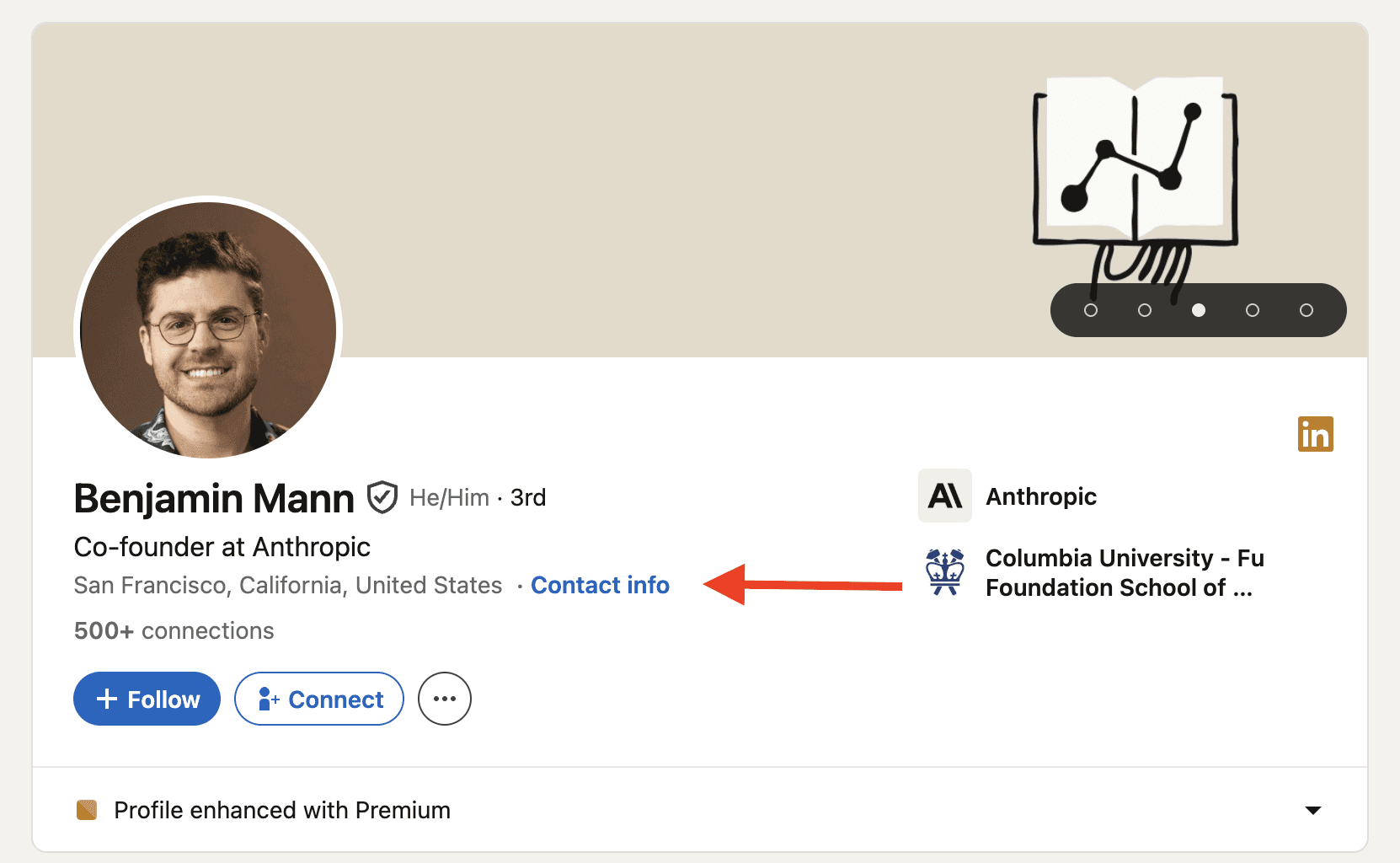
LinkedIn Intelligence: Most founders list their email in the "Contact Info" section. Click "Contact Info" on their profile, it's often hiding in plain sight. For companies with pattern-based emails (firstname@company.com or f.lastname@company.com), identify the pattern from multiple team members.
Apollo Strategy: Apollo find email patterns and verifies addresses. Hunter.io's free tier gives you 900 credits/month. Pro tip: Don't just grab the first email, look for the founder's personal email if they're at a smaller company (<50 employees). Founders often prefer their firstname@companyname emails over generic addresses.
Domain Pattern Recognition: If you find the CMO uses jane.smith@company.com, the founder likely uses john.doe@company.com. Test patterns using email verification tools before sending.
The LinkedIn DM Test: If you're completely stuck, a brief, value-first LinkedIn message asking "What's the best email to send you a quick idea about [specific pain point]?" can work. But only after you've exhausted other options—this move shows you couldn't figure it out yourself.
Verification is Non-Negotiable: Use NeverBounce or Apollo's verification feature. Sending to invalid addresses destroys your domain reputation. A 5%+ bounce rate can land your entire domain in spam folders permanently.
The Direct Decision-Maker Rule: Always email the person who can say yes. For partnerships, that's often the founder or head of BD. For sales, it's the VP of Sales or Revenue. For technical integrations, the CTO. HR for hiring rarely has decision-making power, they're gatekeepers, not gate-openers.
Step 3: ChatGPT Voice Customization & Context Loading
This is the secret sauce that transforms generic AI outputs into emails that sound authentically human and uniquely you.
The Voice Imprinting Process:
Collect Your Best Writing Samples: Gather 3-5 emails or messages you've written that got great responses. Include texts to friends, Slack messages to colleagues, or social media posts that performed well. Variety matters, you want ChatGPT to understand your range.
Voice Analysis Prompt: Open ChatGPT and use this exact prompt:
Paste Your Samples: Drop in your writing samples, then let ChatGPT analyze them. It will create a detailed voice profile.
Save to Custom Instructions: Click your profile icon → "Customize ChatGPT" → Paste the voice profile into "How would you like ChatGPT to respond?" Also add: "I'm a [your role] at [your company/situation], focused on [your goal]. My audience is typically [target audience]. I value [authenticity/directness/humor/whatever fits you]."
Context-Loading for Cold Emails:
Every cold email draft session should start with this context dump:
Step 4: Crafting the Irresistible Subject Line
Your subject line has one job: get them to open. Not to explain everything. Not to be clever. Just to create enough curiosity or relevance that they click.
The High-Performing Subject Line Formulas:
The Specific Compliment: "Loved your take on [specific thing they said]" (28% open rate)
The Mutual Connection: "[Mutual connection] suggested I reach out" (34% open rate)
The Quick Question: "Quick question about [their company's specific initiative]" (31% open rate)
The Relevant Offer: "Idea for [specific pain point you identified]" (26% open rate)
The Personalized Observation: "[Their company name] + [your solution category]" (24% open rate)
What Kills Open Rates:
Generic: "Introduction" or "Partnership Opportunity" (8% open rate)
Salesy: "Grow Your Revenue by 40%" (6% open rate)
Desperate: "Did you see my last email?" (4% open rate)
All caps or multiple exclamation points (spam folder express)
ChatGPT Prompt for Subject Lines:
Even with great research, you won't know what resonates until you test. If you're sending to 20+ similar prospects, try 2-3 subject line variations and track open rates. Double down on winners.
Pro Tip: Superhuman found that subject lines with the recipient's company name or a recent achievement had 2.1x higher open rates than generic alternatives. Specificity always wins.
Step 5: The Hook - Your First 10-15 Words
Founders skim. They receive 50-200 emails per day. If your opening doesn't immediately signal "this is relevant to me RIGHT NOW," you're deleted in under 3 seconds.
The Anatomy of a Killer Hook:
The most effective cold email openings follow this pattern: Specific Observation + Brief Bridge + Relevance Statement
Example Hooks That Work:
"Saw you're hiring 3 new SDRs after your Series B—congrats. Quick thought on ramping them faster..." (References recent news + offers relevant value)
"Your post about CAC:LTV ratios hitting 1:2 resonated. I've helped 4 SaaS founders get that to 1:4+ through..." (Shows they read their content + promises specific outcome)
"After your product launch last week, I noticed your checkout flow has one friction point that's likely costing ~15% of conversions..." (Demonstrates actual research + quantifies value)
What Doesn't Work:
"My name is [name] and I'm the founder of..." (They don't care about you yet)
"I hope this email finds you well..." (Wastes precious opening seconds)
"I've been following your company for a while..." (Vague and sounds like every other email)
The "Smart Compliment" Strategy:
If you're going to compliment them, make it specific and demonstrate understanding:
❌ "I love what you're building"
✅ "Your approach to PLG with enterprise features is smart—most companies pick one or compromise both"
ChatGPT Prompt for Hooks:
Every word in your opening must earn its place. Remove anything that doesn't directly create relevance or curiosity. Founders appreciate respect for their time above all else.
Step 6: The Value Proposition
This is where 80% of cold emails fail. They talk about their product, their features, their achievements. But founders only care about one thing: how you solve their specific problem.
The Before/After/Bridge Framework:
Structure your value prop in three tight sentences:
Before (Their Current Pain): "Right now, you're probably spending 20+ hours/week manually qualifying inbound leads..."
After (The Transformed State): "Imagine that dropping to 2 hours while actually improving lead quality..."
Bridge (Your Solution): "That's what we built for [similar company]—an AI qualifier that learns your ICP and handles first-touch conversations..."
The Proof Stack:
Founders are skeptical by nature. Your value prop needs credibility markers:
Specific Metrics: "Reduced churn from 8% to 3% for 2 B2B SaaS companies"
Relevant Social Proof: "Working with [company in their space] and [another competitor]"
Risk Reversal: "30-day pilot, no commitment, we build the first integration free"
What Strong Value Props Look Like:
"I helped [similar company] go from 14% email reply rate to 38% by completely rebuilding their cold outreach system. The framework takes about 90 minutes to implement..."
"After analyzing 50+ SaaS pricing pages, I found 3 psychological friction points that typically cost 12-18% of trial conversions. I noticed [specific thing] on your page and have a quick fix..."
"I've ghostwritten LinkedIn content for 8 founders in your space that generated a combined 2.3M impressions and 400+ qualified inbound leads. Happy to share the playbook..."
ChatGPT Prompt for Value Props:
The "So What?" Test: After writing your value prop, read it and ask "So what?" If you can't immediately answer with a tangible business outcome, rewrite it.
Avoid These Value Prop Killers:
Jargon and buzzwords ("leveraging AI-powered synergies...")
Vague benefits ("help you grow your business")
Focusing on process ("we use a 7-step methodology...")
Making it about your company ("we've won 12 awards...")
Step 7: The Low-Friction Call-to-Action
You've gotten them to read this far. Don't blow it with a CTA that requires too much thinking, decision-making, or commitment.
The Friction Hierarchy (from lowest to highest):
Reply with one word: "Interested?" or "Worth a conversation?"
Reply with a simple yes/no: "Want me to send over the analysis?"
Pick a time (with limited options): "I'm free Tuesday at 2pm or Wednesday at 10am—either work?"
Schedule via calendar link: "Here's my calendar if you want to grab 15 minutes"
Request demo/long meeting: "Can we schedule a 45-minute discovery call?"
The Most Effective CTAs for Cold Emails:
The Micro-Commitment: "Worth exploring?" (2 words, yes/no answer)
The Low-Stakes Next Step: "Should I send over the 5-minute case study?" (Not asking for their time, just permission to share)
The Binary Choice: "Interested in the breakdown, or should I stop here?" (Makes "no" feel acceptable, which paradoxically increases "yes" responses)
The Curiosity Hook: "I built something specific for [their situation]—want to see it?" (Implies you've already done work FOR them)
Why These Work:
According to Gong.io's analysis of 1M+ sales emails, CTAs that require less than 10 seconds of cognitive load have 3.2x higher response rates than those requiring decision-making or scheduling.
The Multiple-CTA Mistake:
Never give them multiple options in one email:
"Would love to set up a call, or if you prefer, I can send a proposal, or maybe we could connect on LinkedIn first?"
This creates decision paralysis. One email, one clear next step.
ChatGPT Prompt for CTAs:
The "Reply Speed Psychology" Hack:
End with something that can be answered in 2 seconds: "Yes/no—worth a look?" People are 4.7x more likely to reply when the response requires minimal effort. Once they've replied (even just "Sure"), you've opened a dialogue. That's when you can introduce bigger asks.
Advanced Move - The Assumptive Close:
For highly qualified prospects where your research shows strong fit: "I'll send the framework tomorrow unless you'd rather schedule a call to walk through it together—preference?"
This assumes they want it (confidence signal) while giving them control (reduces pressure).
Step 8: The Complete Email Assembly Using ChatGPT
Bringing All Elements Together Into One Cohesive Message
Now that you have all the components researched and planned, it's time to use ChatGPT to assemble them into a polished, ready-to-send email.
The Master Prompt Template:
What ChatGPT Will Generate:
With this detailed prompt, ChatGPT will produce a complete email that:
Has a personalized, relevant subject line
Opens with a specific hook demonstrating research
Presents value in terms of their outcomes
Includes appropriate proof points
Ends with a frictionless CTA
Matches your authentic voice
The Critical Review Checklist:
Before you send, review the draft against these criteria:
The Skim Test: Read only the first and last sentence. Do they make sense together? Does the email have a clear thread?
The Stranger Test: Remove the recipient's name and company. Does this email sound like it could be sent to anyone? If yes, add more personalization.
The "So What?" Test: After each sentence, ask "Why should they care?" If you can't answer, delete that sentence.
The Word Count: Under 150 words is ideal. 100 is even better. Every word over 150 reduces reply rates by ~2%.
The Passive Voice Check: Active voice sounds more confident and direct. "I helped Company X reduce churn" vs "Company X's churn was reduced."
The Jargon Detector: Remove any word you wouldn't use when talking to a friend at a coffee shop.
Example of a Complete ChatGPT-Generated Email:
Why This Works:
Subject line references specific recent activity
Opening proves you read their content and understand their pain
Value prop is outcome-focused with proof
You've already created something FOR them (investment signal)
CTA requires 2-second yes/no response
Step 9: The Email Signature That Builds Credibility
Most people phone in their email signature. Founders notice. A strategic signature can add 15-20% more credibility to your email.
What a Strong Cold Email Signature Looks Like:
Example:
What to Include:
Your Name: First and last, professionally formatted
Title + Company: Be specific about what you do
One-Line Descriptor: The outcome you deliver, not the process
Website Link: They WILL check if they're interested
LinkedIn Link: Makes it easy for them to verify you're real
Optional P.S. Credibility Booster: Recent client, speaking engagement, publication
What NOT to Include:
Phone number (creates pressure, they're not ready for a call)
17 social media links (makes you look like you're begging for followers)
Inspirational quotes (unprofessional in B2B context)
Company logo images (many email clients block images by default)
Long legal disclaimers (this isn't a contract)
If you have relevant social proof, add it as a P.S. It's the second-most-read part of any email (after the first line). Examples:
"P.S. - Just finished a similar project with [competitor/company in their space]"
"P.S. - Speaking at [relevant conference] next month about this exact topic"
"P.S. - That analysis I mentioned? Here's what it looked like for [similar company]: [link]"
60% of emails are opened on mobile first. Keep your signature to 3 lines maximum before the P.S., or it will dominate the screen and look aggressive.
Step 10: A/B Testing & Iteration
Treating Cold Email as a Scientific Experiment, Not a Creative Writing Exercise
The best cold emailers don't write one perfect email—they systematically test variables to find what works for their specific audience.
What to Test (One Variable at a Time):
Subject Lines: Test 2-3 variations per campaign
Personalization level (company name vs. specific achievement)
Length (30 characters vs. 50 characters)
Question vs. statement format
Opening Hooks:
Research-based observation vs. mutual connection
Compliment vs. insight vs. question
Length (one sentence vs. two)
Value Prop Positioning:
Feature-focused vs. outcome-focused
Case study mention vs. no case study
Metric-heavy vs. story-based
CTA Types:
Yes/no question vs. calendar link vs. "send more info"
Assumptive vs. permission-based
Email Length:
75 words vs. 150 words vs. 200 words
Send Times:
Morning vs. afternoon
Different days of week
How to Structure Tests:
Divide your prospect list into groups of 20-30 similar contacts. Send Version A to half, Version B to half. Track:
Open rate (subject line test)
Reply rate (everything else)
Positive reply rate (replies expressing interest)
Sample Size Matters:
You need at least 30 emails per variation to get statistically meaningful results. Anything less and you're just guessing.
What Good vs. Great Looks Like:
According to Woodpecker's 2024 benchmark data:
Average cold email performance:
Open rate: 20-25%
Reply rate: 3-5%
Positive reply rate: 1-2%
Top 10% performance:
Open rate: 40-50%
Reply rate: 15-20%
Positive reply rate: 8-12%
If you're below average, something fundamental is wrong (list quality, deliverability, or message relevance). If you're at average, systematic testing can get you to top 10%.
The Compound Effect:
Small improvements stack:
Improve subject line: +5% open rate
Improve hook: +3% reply rate
Improve CTA: +2% reply rate
Better send timing: +4% open rate
Combined: These "small" changes can double your results.
ChatGPT for Testing Variations:
The Winner's Iteration Loop:
Send batch of 30-50 emails (Version A)
Wait 5 business days for results
Identify weakness (low opens? Low replies? Wrong audience?)
Create variation testing that weakness (Version B)
Send to next 30-50 emails
Compare results
Keep winner, repeat process
Top cold emailers run this loop every 2 weeks. Their emails in month 6 look completely different from month 1—because they've evolved based on data, not assumptions.
Step 11: The Follow-Up System That Respects Their Time
83% of sales require 5+ touchpoints to close. But 44% of salespeople give up after one email. The key is following up with value, not desperation.
The 3-Touch Maximum Rule:
For cold outreach, never send more than 3 emails total (1 initial + 2 follow-ups). After that, you're hurting your brand more than helping.
Follow-Up Framework:
Email 1 (Day 0) - The Opener:
Research-based hook
Clear value proposition
Low-friction CTA
Email 2 (Day 4-5) - The Value Add:
Acknowledge they're busy (don't apologize)
Add NEW information (new case study, new insight, recent news)
Different CTA angle
Email 3 (Day 10-12) - The Permission Close:
Give them an easy out
Offer value even if they say no
Implied final touch
Example Follow-Up Sequence:
Email 1:
Email 2 (4 days later):
Email 3 (10 days after original):
Why This Works:
Email 2 adds new value and references new company activity (you're paying attention, not just following up)
Email 3 gives them an out and offers value regardless (removes pressure, builds goodwill)
You've demonstrated persistence without being pushy
Each email can stand alone if they missed the previous ones
The "Breakup Email" Technique:
If you're going to send a 3rd touch, make it a "permission to close your file" email:
These get 20-30% response rates because:
They're refreshingly honest
They give the prospect control
They're easy to reply to (just "close it" or "check back in Q3")
What NOT to Do in Follow-Ups:
❌ "Just bumping this up in your inbox"
❌ "Did you see my previous email?"
❌ "Following up on my email from [date]"
❌ "I'm sure you're busy but..."
❌ Resending the exact same email
These show you have nothing new to offer and are just pestering them.
Automation Tools for Follow-Ups:
Lemlist, Woodpecker, Reply.io: Automate sequences while keeping them personal
Boomerang, Mixmax: Schedule follow-ups if someone doesn't reply
HubSpot Sequences: For those already in HubSpot ecosystem
Pro tip: Even with automation, manually check if anything changed with the company before each follow-up sends. Takes 30 seconds and can make your follow-up 10x more relevant.
Step 13: Advanced Personalization Techniques
Going Beyond Name and Company for 10X Response Rates
Basic personalization (using their name and company) is table stakes. Advanced personalization creates "How did you know that?" moments.
The "Recent Activity" Deep Dive:
Instead of just mentioning their recent LinkedIn post, go deeper:
Surface Level: "Saw your post about cold email"
Deep Level: "Your point about reply rates dropping after 150 words resonated—I tested that with 200 emails last month and found the same 150-word cliff. But I also found one exception: when the value prop includes specific metrics, 200 words still performed at 18% reply rate vs. 14% for shorter versions. Curious if you've seen that?"
You're not just showing you read it—you're engaging with their idea at a substantive level.
The "Before You Email" Research Checklist:
Spend 5 extra minutes finding:
Their content consumption: What do they retweet, like, or comment on? This reveals their interests beyond their public posts.
Their hiring patterns: Who are they hiring? This reveals where they're investing and what problems need solving.
Their customers: Who are they selling to? This helps you speak their language.
Their tech stack: What tools do they use? (BuiltWith, Datanyze) This reveals workflow and potential integration points.
Their engagement patterns: Do they reply to LinkedIn comments? Engage with others' content? This indicates if they're active and responsive online.
The "Mutual Ground" Framework:
People reply 3x more when they perceive you as "one of us" rather than "one of them." Find mutual ground:
Shared geography: "Fellow SF founder here..."
Shared background: "Also came from the agency world before SaaS..."
Shared challenge: "Like you, I've struggled with [specific problem]..."
Shared connections: "Both in [community/group name]..."
Shared interest: "Saw you're also into [specific hobby/interest]..."
Not manufactured—genuinely find real common ground.
The "I Built This FOR You" Technique:
The most powerful personalization is creating something specifically for them before asking for anything:
Loom video analyzing their website (3-5 minutes)
Google Doc with specific recommendations
Figma mockup of a solution for their use case
Spreadsheet analyzing their competitors
Example:
This gets 40-60% response rates because:
You've invested time before asking anything
You've provided value regardless of their response
You've demonstrated expertise through action, not claims
The "Negative Personalization" Tactic:
Sometimes pointing out what you DON'T do is more powerful than what you DO do:
"I noticed you're not doing [X] yet. Most companies in your space are, but I actually think you're smart to avoid it because [specific reason based on their business model]. Here's what I'd do instead..."
This shows deep understanding of their specific situation and builds credibility fast.
ChatGPT for Advanced Personalization:
The Personalization ROI:
Basic personalization (name + company): 3-5% reply rate Medium personalization (recent activity + pain point): 8-12% reply rate Deep personalization (custom analysis + specific insight): 20-40% reply rate
The time investment scales exponentially, but so do the results. Use deep personalization for your top 10-20 dream prospects. Use medium for everyone else.
Final Thoughts: The Cold Email Mindset
The best cold emailers don't think like marketers—they think like researchers and consultants. Every email is a hypothesis about what that specific person cares about right now.
What separates 5% response rates from 30%:
5% response: Generic template with name swapped in
15% response: Decent research + clear value prop
30%+ response: Deep research + custom insight + low-friction CTA + perfect timing
The difference isn't writing skill—it's empathy, research quality, and systematic testing.
The Cold Email Hierarchy of Needs:
Deliverability (foundation): Your email must reach their inbox
Relevance: Your offer must match their current needs
Credibility: They must believe you can deliver
Timing: You must catch them when they're receptive
Clarity: Your ask must be brain-dead simple
Personality: Your voice must sound human and authentic
Master these in order. Skip none.
Use ChatGPT as your research assistant and draft generator, but never as a replacement for genuine curiosity about the human on the other end. The best cold emails don't feel like cold emails at all, they feel like a smart peer reaching out with something genuinely useful.
Now go write some emails that get replies.
You May Also Like











Featured Tools
Newest Additions








AI Image & Video Generation














Vibe Coding Library

























Screenshot & Screen Recording Tools